'a hu 'u fi conlang
yi wa ka yi 'a hu 'u - 'a hu wa [ 'a hu 'u fi ]
Home // About // Learn the Language! // Community // Contact
Learn 'a hu 'u fi (For English speakers)
ha 'a 'u mu! In this section, you will learn the language. If you want to see the pamphlet in Russian, go here.
Grammar
'a hu 'u fi uses the SOV (Subject-Verb-Object) word order. This is the word order used most commonly around the world.
An example of this word order can be described as switching the verb and object of an English sentence around. Like "He pizza wants" would be used.
There are no articles, or words for "is", "are", and "am".
You must take the 30 words in this language and combine them to make meanings. If you try hard enough, you can get many interesting meaings for it.
I personally cannot advise you to try to make up your own words, as that would ruin the purpose of this language. When describing sentences that would use "is"
"am" or/and "are", you must use a hyphin or an em-dash. Similar to Russian.Proper noun rules
For proper nouns, you must translate the words of that PN into 'a hu 'u fi equivalents. The proper nouns must also be bracketed to show that they are a name of something rather than a fully fleshed out word. You must use "yi wa" before the PN to indicate that it's a person's name, "fu wa" for a place, and " 'a hu wa" for a language. You must also replace any letters of the PN from another language and replace them with the closes approxement, according to the chart below.
E becomes I
O becomes U
B becomes P
V and PH becomes F
(Voiced and Unvoiced) Th becomes F
R, WH and L becomes W
Q, X and G, C, KH, GH, CH becomes K
S, Z, J, SH (English pronunciation) and D becomes T
And you must put the vowel "I" at the end
Vocabulary
There are 30 words in 'a hu 'u fi. Each of the consonants indicate that the word itself is a part of a category. They are as following:
'_ = preposition and starting
f_ = indicator of occurrence
h_ = mood
k_ = tense
m_ = pronoun
n_ = value
p_ = colour
t_ = texture
w_ = numeral
y_ = decision
And the 30 words themselves are:
‘a - ahh!, to speak, to shout, to express, an opening, a mouth (the interjection word)
‘u - the locative, genitive, and dative preposition
‘i - the instrumental preposition, the conjunction
fa - question marker, what, mysterious
fu - a location, an area, a spot, there
fi - time, measurement
ha - good, silly, fun, laughter
hu - power, energy, healing, to think
hi - to sense, the five senses and beyond
ka - past tense
ku - present tense, now, here
ki - future tense
ma - first person pronoun
mu - second person pronoun
mi - third person pronoun, this, it, that
na - not, null, void
nu - yes, any, correct, true, proper
ni - or, maybe, to compare, to differ, average, can
pa - red, scarlet
pu - yellow, golden
pi - blue, navy
ta - solid, hard, firm, compact
tu - liquid, flexible, round, blob-like
ti - gas, mist, fog, smoke, air, wind
wa - one, a thing, a piece, a part
wu - many, plural word for all other forms of speech, more, a lot of
wi - all, infinite, plural word for pronouns
ya - to need, to be mandated, important, essential
yu - to want, to desire, to hope for, to beg, to pray
yi - to move, to be, to live, to go, to act
And then there are some word combinations:
'u fa fu - where
'u fa fi - when
'u fa - why
'u fa wa - who
'i 'u - and
'i na 'u wa - but
'u ma - I have (Like in Russian)
pi tu - water
pu tu - urine
hu pu tu - oil
Sentences
Here are some example sentences I made:
I knew a man by the name of Steven.
ma ji wa ka hu ‘u ‘a fi - ji wa [ ti ti fa ni ].
Get in the car, shut the door!
yi ‘u hu yi wa - ‘i ‘u na ‘a ta yi wa!
There are lots of opportunities in life.
mi wi - wu mu wa ‘u yi fi.
I am not there.
mu na nu fu ‘u ku.
I want pizza.
ma pu ta 'i pa tu 'a wa yu.
The Abjad
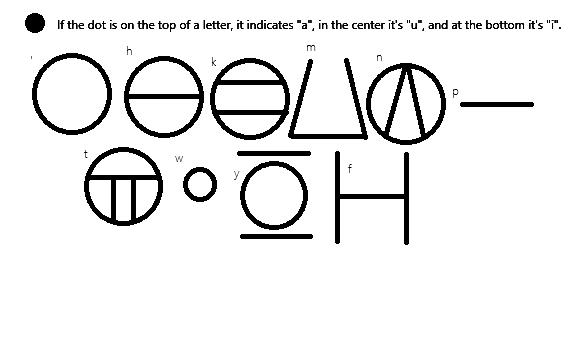
'a hu 'u fi also has its own custom writing system. It uses an abjad based off of Arabic's abjad. But the difference is that you MUST mark vowels, unlike arabic.
Here it is below: